Find your local technical manager
If you have a quesction about our products on your crops, please contact your nearest technical manager
Barley is the second most important crop in the United Kingdom. Growing a high yielding good quality barley crop is often as important for the profitability of the overall farm roataion as doing the same for wheat. From crop establishment to maintaining healthy green leaf area through grain fill – at Bayer we’re here to help with your barley agronomy needs.
Target:
Pre-drilling, rotational strategies
Key aim:
Reduce the levels of the disease in a crop by using an integrated strategy involving varietal resistance, controlling the green bridge, drilling date and trash burial.
Varietal resistance:
Planting varieties which are less susceptible to diseases can significantly diminish the levels of infection. Resistant varieties are best used in circumstances where disease risk is higher i.e. earlier drilled crops. Be careful to select a variety which has good resistance to the most prevalent diseases in your area. The graph below shows how a resistant variety, used in combination with a fungicide programme, can increase the return on investment of fungicides.
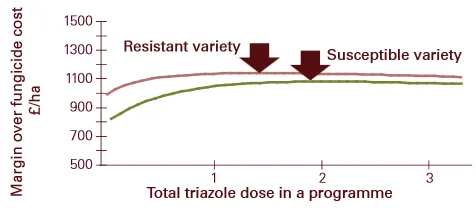
Source: HGCA Barley disease management guide 2014
Controlling the green bridge:
Barley brown rust and powdery mildew both overwinter on volunteers. Ensure that volunteers are sprayed off on overwintered stubbles to control the inoculum levels in following and nearby crops
Drilling date:
Although planting crops earlier may increase the chance of maximising the yield it will significantly risk of disease epidemics. If you are planning to drill early then consider offsetting the increased risk by choosing a variety with good resistance.
Cultivations:
Spores fromboth Rynchosporium and net blotch over winter on trash from the previous crop. If growing a crop adjacent to or after a previous barley crop then consider burying the trash by ploughing.
Benefits:
Controlling disease as part of an integrated crop management approach, using both cultural and chemical control, will reduce the overall levels of infection and maximise yields.
Timing:
GS 23 – 30 (winter barley)
Target:
Later tillering (winter barley) in high pressure situations
Key aim:
To reduce inoculum levels of established powdery mildew and Rhynchosporium on susceptible varieties. This will aid tiller survival and spikelet production, as well as reduce the disease pressure for further T1 and T2 fungicide applications.
Recommendation:
Mildewicide +/- cyprodinil (depending on Rhynchosporium pressure).
Timing:
GS 25 - 31
Target:
Mid to late tillering (spring barley) or leaves 3 and 4 (winter barley)
Key aim:
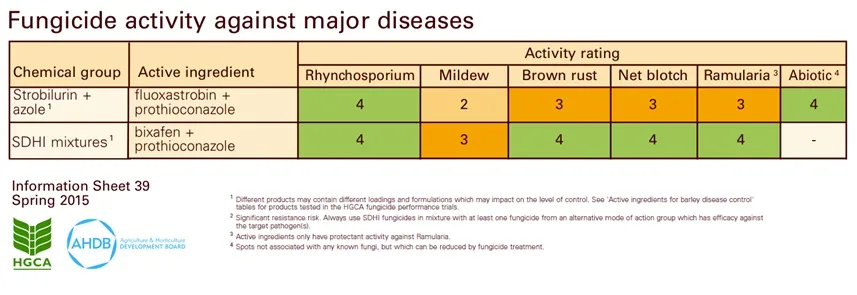
Targeting the early season disease threats: Rhynchosporium, net blotch, mildew and brown rust: aiming to protect leaf 3 from all foliar disease, to eradicate disease on leaf 4 and to ensure effective suppression of stem base disease to optimise tiller survival.
Timing:
GS 39 – 49 (spring barley) or GS 29 – 31 (winter barley)
Target:
Top three leaves (spring barley) or leaves 1 and 2 (winter barley)
Key aim:
Protect the upper canopy from the main disease threats: Ramularia, Rhynchosporium, net blotch, mildew and brown rust. To maintain green leaf area for as long as possible during grain fill and protect grain quality which is especially important for malting barley.
The addition of 1 L/ha of CTL to either Fandango or Siltra will increase the control of Ramularia

If you have a quesction about our products on your crops, please contact your nearest technical manager