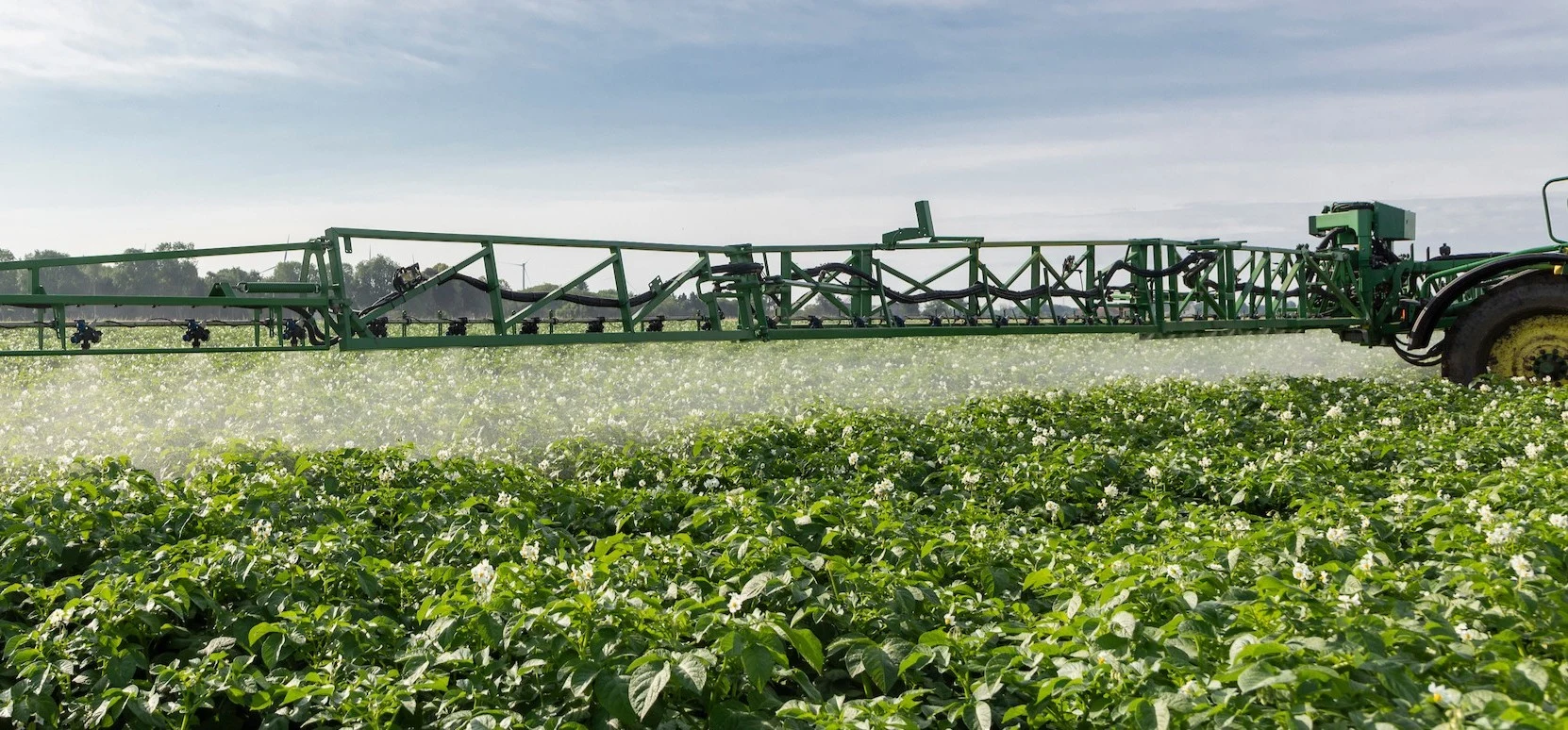
This month’s update reflects a season that has moved quickly, with crops pushed on by heat and yellow rust driving many of the discussions at Hinton. Jenny Deakin looks at what stood out in the trial work, why balanced fungicide programmes still matter, and how to think about glyphosate timing, water quality and current potato Alternaria pressure.
Author
Jenny Deakin | 8th July 2026Tags
July agronomy advice South, Central and East – rust, glyphosate and potatoes
This has been a season that seems to have rushed at the end. Across the southern eastern and central areas, crops are forward, barley is starting to come off and where desiccation was needed, timings have generally been easier to judge because crops have been more even.
At the same time, the Hinton story has really been about rust. That has shaped a lot of the conversations through June and into July, alongside some very practical questions on harvest management, water quality and how to keep potato programmes straight in a hot spell.
Harvest timing and desiccation calls
Around this area, most of the key cereal jobs are largely done. Some growers have gone in with desiccation, some have looked again and decided they may not need to, and that feels very season-specific rather than a fixed rule.
What has helped is the relative evenness of crops. There has been less of that stop-start debate over whether the headlands are ahead and the middle is behind, so for many people it has been easier to make a decision and move on.
Jenny’s advice with regards OSR is to keep it simple and keep walking crops. “Just go out and check the crop, check the pods, and see what stage they’re at,” because last week’s heat has moved things on faster than most people would have expected.
Glyphosate and water quality
Where glyphosate is being used for harvest management, the water source needs a bit more thought than usual this year. Supplies have been variable, and once people start pulling water from awkward sources, the risk is they create problems in the tank before they even get to the field.
The main watch-out is hard or poor-quality water extracted from sources that may be running low. In those situations, Jenny’s advice is to pay attention to pH and water conditioning, and not to over-correct with acids in a bid to save a few pennies and end up creating a much more expensive headache in years to come.
That was one of the more memorable messages from recent conversations. Some growers were reporting very low pH after adding fulvic or citric acid in a bid to reduce the dose rate or up the efficacy, which is exactly the sort of corner-cutting that can cause avoidable issues.
A good glyphosate formulation with built-in support for water conditioning is the safer route, especially in the southern hard water areas. The practical message is not to improvise, and not to assume all water behaves the same just because the crop looks ready to go.
Yellow rust at Hinton – the main story
If there has been one clear theme at Hinton, it has been yellow rust. Jenny says that from early on it became obvious that some of the familiar Group 3 and Group 4 types were struggling with this new strain of yellow rust, with the sharp temperature changes across the months impacting how varieties reacted in real time.
“Champion and Bamford were particularly hard hit in the untreated. In places they had been heavily defoliated by rust, right down the canopy to the base.”
That made the treatment differences easy to see. In the variety blocks, Plaxium® stood out strongly on green leaf area, and in the programme work there were again some obvious gaps between the more persistent options and those where disease had come back in the interval between timings.
At the demo evening this year growers could see it for themselves. Jenny described people effectively playing a guessing game in the plots and repeatedly picking out the stronger treatments without being told what they were looking at.
Balanced programmes still mattered.
Even in a season where yellow rust has shouted the loudest, Jenny is clear that the answer is not to become too narrow in your thinking. Yellow rust and Brown rust is there, Septoria is still the biggest yield robber, and a programme that leans too hard one way can still leave a gap somewhere else.
That was one of the most useful take-homes from Hinton. Some products were clearly strong on rust, but the better programmes were the ones that still held the baseline Septoria position as well, because there are very few varieties now with only one weakness to think about.
It is also worth saying that stronger programmes did more than tidy up disease. In a dry, hot spell the difference in green leaf retention and general plant resilience was visible, which is why Jenny keeps coming back to the value of a well-rounded programme rather than simply chasing the cheapest answer at one timing.
Potatoes and Alternaria pressure
Potatoes are a smaller part of the picture around Hinton itself, but further across the south coast and east anglia there are enough crops under pressure for this to matter in July. Recent heat has left some crops looking stressed, and where canopies have been checked by weather, Alternaria becomes much easier to find its way in.
Jenny’s feeling is that this is one to keep firmly on the watch list now. Some crops have just caught enough rain to stop them rolling up too badly, but you would not want that stress period to drag on much longer.
That is why more questions are now coming through on where Caligula® fits. Caligula® contains fluopyram and prothioconazole and is used for Alternaria control in potatoes as part of a correctly timed programme.
The important point, as Jenny puts it, is that it sits on top of the late blight programme, not instead of it. That distinction matters, particularly this season, because growers can no longer utilise mancozeb in their programmes, so they are having to think harder about how the Alternaria piece fits without weakening blight protection.
In practical terms, this is about programme discipline. If a crop is heat-stressed and Alternaria risk is building, that does not mean blight risk disappears; it means the programme has to do both jobs properly, and growers need to be clear which product is there for which reason.
Looking ahead to next season
When Jenny looks beyond harvest, the main lesson is to spread risk better in the variety choice. You are unlikely to escape disease pressure completely, but you can avoid putting too much area into one vulnerable variety and making next spring harder than it needs to be.
Her thinking is to avoid having all variety choices with similar disease scores but balance it with more resilient material so spray timings are easier to manage and products are not put under quite so much pressure. In a season like this one, that feels less like theory and more like a very practical way of keeping options open.
Plaxium® contains isoflucypram, fluopyram and prothioconazole. Caligula® contains fluopyram and prothioconazole. Plaxium and Caligula are registered trademarks of Bayer. All other brand names used are Trademarks of other manufacturers in which proprietary rights may exist.Use plant protection products safely. Always read the label and product information before use. Pay attention to the risk indications and follow the safety precautions on the label. For further information, including contact details, visit www.cropscience.bayer.co.uk or call 0808 1969522. © Bayer CropScience Limited 2026