Author
Darren Adkins | 6th May 2026Tags
Cereal disease management: May T2 decisions in the East and South
Across Darren’s area in East Anglia and the South of England, winter wheat crops are generally looking well and carrying plenty of yield potential. Most fields were drilled from mid-September onwards, with the majority of the wheat being in the ground by around mid-October, and the remainder safely in the ground following root crops in the run up to the New Year.
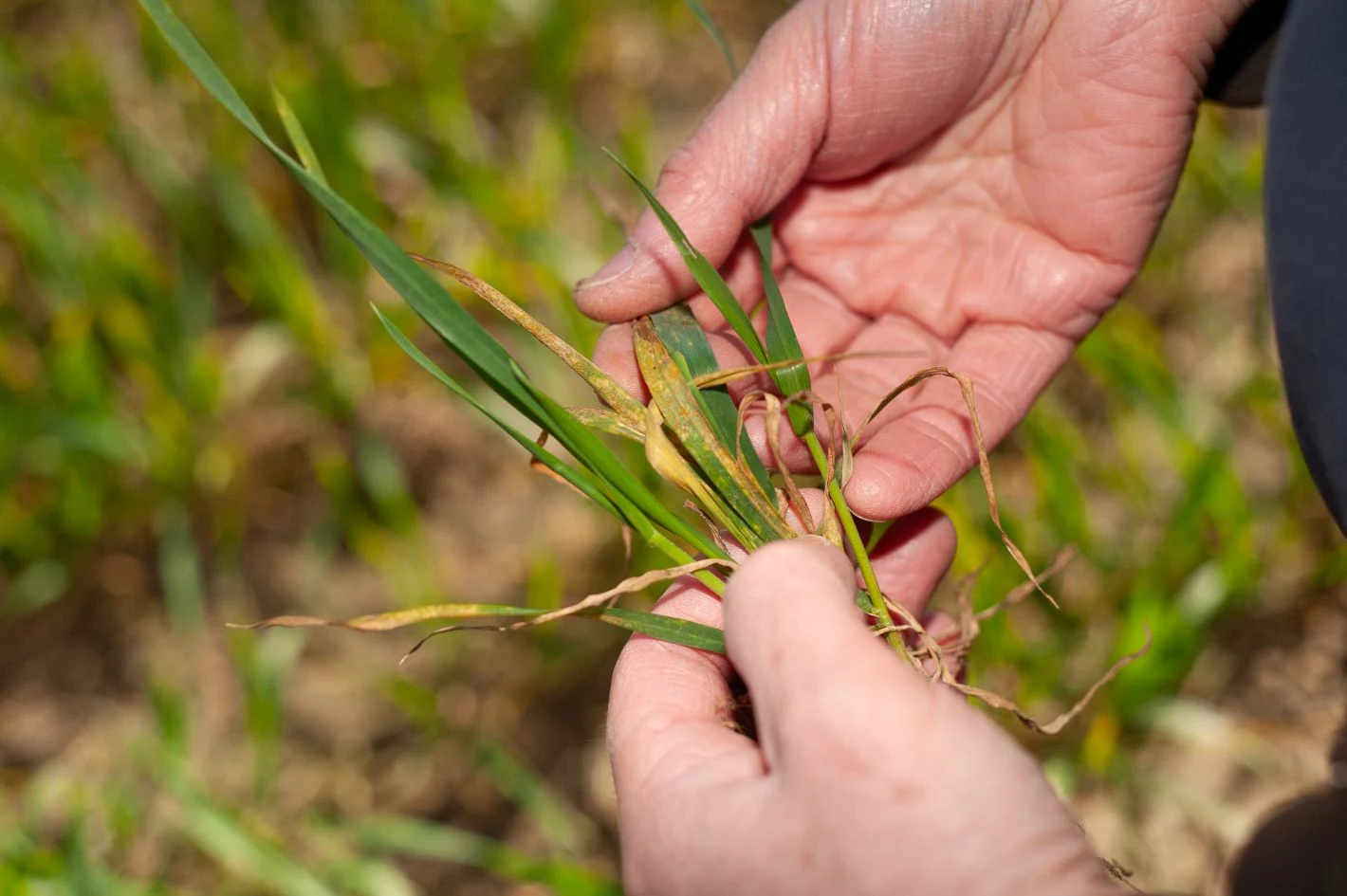
Through February and March, a wetter spell pushed Septoria on, but conditions have since turned much drier. As it dried up, yellow rust has become easier to find, particularly in known susceptible varieties and forward, early drilled crops. By the end of April, most growers had applied their T1, even with the cooler conditions holding back crop development and big differences in varietal growth patterns showing up clearly.
The key now is not to take the foot off the pedal. With good yield potential in the ground, Darren’s focus is on helping agronomists and growers protect that potential with sensible, planned T2 decisions that reflect what’s actually in their fields – not just what’s being talked about elsewhere.
At the time of writing, it was too soon to know how T1’s have performed but a quick assessment would suggest that:
Many growers looking for a broad-spectrum T1 have gone with Ascra® as an all-rounder: being strong on yellow rust, suppressive on Septoria and covering off the stem base diseases.
This was a tactical decision to leave the flag leaf spray choices open for stronger Septoria chemistry at T2 such as isoflucypram, fenpicoxamid or pydiflumetofen if the weather turns wetter in the interim.
Where crops were looking under pressure from yellow rust and Septoria there was strong demand for Plaxium® and the Vimoy® box offers which provide a solid foundation with great longevity of protection.
Some agronomists decided that the crops needed the most robust protection from Septoria and so used fenpicoxamid where the pressure was at its highest.
Top 3 things to watch in May
1. Yellow rust building in susceptible winter wheat varieties
2. Septoria sitting low in the canopy, not a threat now but ready to move if it turns wet again
3. T2 planning – matching fungicide choices to what was used at T1 and to real field conditions
T2 in winter wheat – Darren’s scenarios and options
A lot of the T1 conversation in April was dominated by yellow rust, with Septoria becoming less of a threat as we entered a dry April. Going into T2, Darren works through the scenarios which growers and agronomists should be considering.
1. Lower disease pressure with current dry conditions continuing through May:
Ascra® 1.2L/Ha
This fits where: T1 has already done a decent job and disease is present but not racing, fields have good potential and lower disease pressure and situations where growers want to protect yield without overspending using a strong all-rounder in a single can solution.
2. Higher disease pressure if the weather turns wetter but timings are not impacted:
Plaxium® 1.2 L/Ha
This fits where: we need excellent control of both yellow and brown rusts especially on farms with varieties that are susceptible to both strains, that want to deliver excellent Septoria protection to the vital flag leaf while also simplifying their spray operations by using a single co-form. Think of it like “Turbo Ascra”.
3. Septoria and Rust become rampant with multiple rain events, and the flag leaf timing is compromised
Jessico® Fusion 1.2 L/Ha
This fits where: disease pressure requires the strongest chemistry on Septoria, and both rusts combined in an innovative solution.
In order to comply with label restrictions Agronomists need to plan T2 options around what has already been used at T1:
If a product containing isoflucypram has been used at T1, then another product containing isoflucypram should not be used at T2.
Similarly, if fenpicoxamid has been used at T1, that also means another fenpicoxamid product should not be used at T2.
The message from Darren is clear: agronomists really do have to map out their programmes, not just pick T2 in isolation. Knowing exactly what’s gone on at T1 is essential to keep the right tools available at T2.
Darren’s Key Take-aways
T2 in winter wheat
Focus on the flag leaf. Use a balanced programme or a stronger Septoria product where warranted. Match fungicide choice to the disease that’s actually in the field, not just what’s being talked about elsewhere.
Programme planning
Plan around what’s already been used at T1. Make sure T2 choices are compatible with earlier chemistry and resistance guidelines. Keep timings tight – hit the right leaf at the right time and you won’t go far wrong.
Farm what’s in front of you
Darren stresses the importance of dealing with what’s in front of you:
“A lot of people ring up saying they’ve heard about this or that problem, and the first question is: is it actually affecting you, or have you just heard about it on the grapevine?” Conditions and disease pressure can change quickly, and what’s topical nationally isn’t always what matters in your own fields.
Final words from Darren
“Crops across the East and South have got a lot of potential this year, so the big thing now is not to let standards slip at T2. If we base our fungicide choices on what’s really in the field, time them right on the flag leaf and don’t get distracted by noise from elsewhere, we’ll give ourselves every chance of turning that potential into yield.”
Ascra® Xpro® contains bixafen, fluopyram and prothioconazole. Jessico® Fusion contains isoflucypram and fenpicoxamid. Plaxium® contains isoflucypram, fluopyram and prothioconazole. Vimoy® (Iblon®) contains isoflucypram. Ascra®, Vimoy®, Iblon, Xpro, are registered trademarks of Bayer. All other brand names used are trademarks of other manufacturers in which proprietary rights may exist. Use plant protection products safely. Always read the label and product information before use. Pay attention to the risk indications and follow the safety precautions on the label. For further information, including contact details, visit www.cropscience.bayer.co.uk or call 0808 1969522. © Bayer CropScience Limited 2026