Author
Tom Sowerby | 6th May 2026Tags
Cereal disease management: T2 decisions loom in the North this May
Across Tom’s area, winter cereals are generally in good shape with plenty of yield potential. Most wheat went in from mid-September and at the time of writing in the last week of April had reached leaf 3 emerged, with T0’s having done a solid job on early yellow rust. Mornings remain cold however with what rainfall there has been, being limited to passing showers, which has helped slow disease, but the threat of Septoria and rust in crop canopies remains. T1 sprays will have been applied in the last week of April into early May with reports of quite a few agronomists and growers choosing a Vimoy® / isoflucypram-type option at T1, due to its excellent rust and Septoria activity.
Potato planting is ongoing, most spring barley and sugar beet are in, and maize drilling will be getting going after waiting on soil temperatures. For agronomists and growers, the month of May is a juggling act of locking in all that potential with well-judged fungicide decisions, whilst having to keep an eye on budgets and available spray days.
Septoria and rust are present in most wheat crops, but not currently at crisis levels. The risk is that a shift to wetter, milder weather between now and T2 could rapidly escalate Septoria and that rust could flare again on susceptible varieties if protection tails off should there be a delay between T1 and T2 and the interval is stretched past 3 weeks.
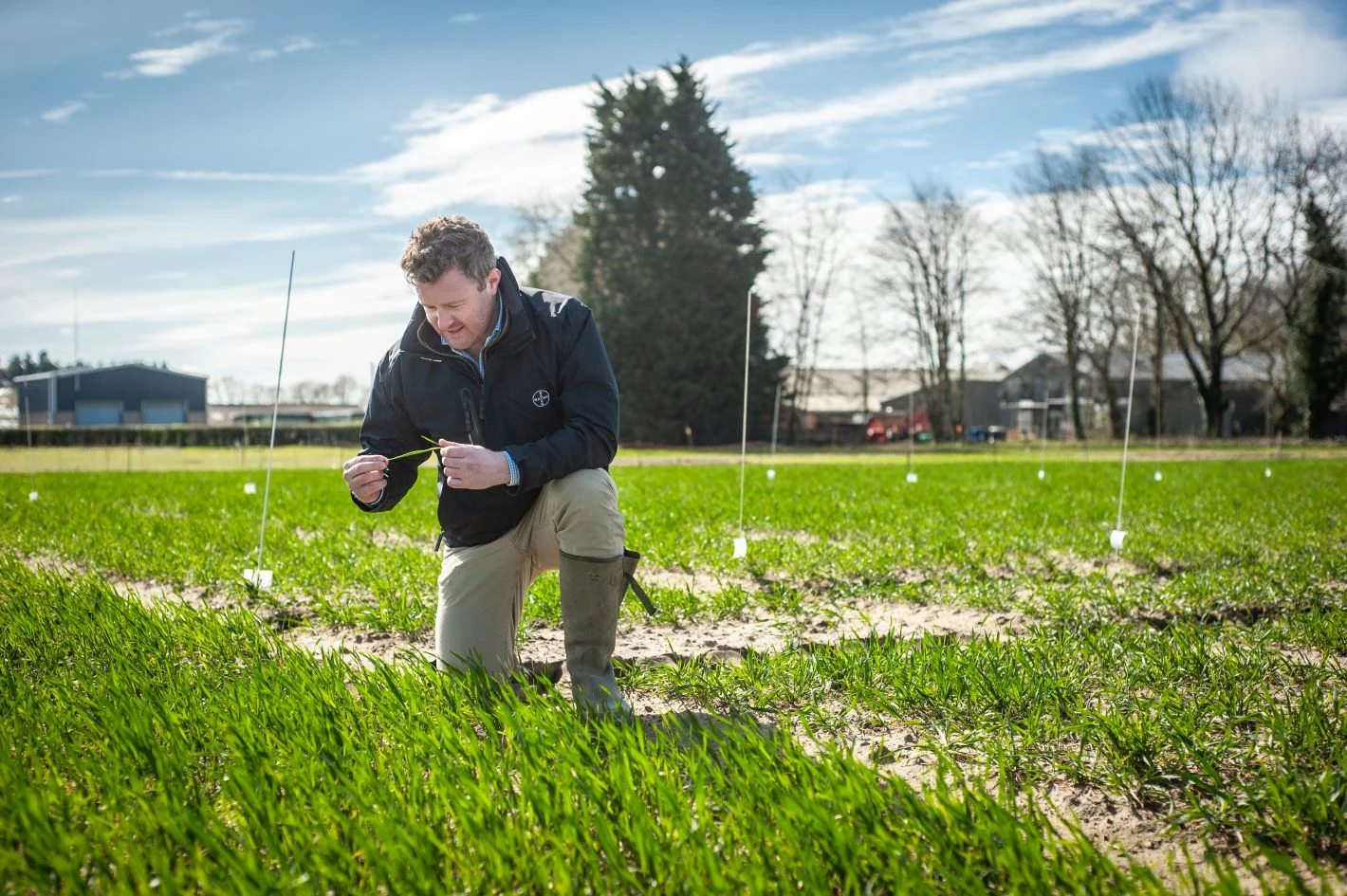
Tom recommends to keep walking crops at short intervals and get down in the base as even if canopies look clean from above the lower leaves could well be harbouring Septoria lesions. Adjust plans for the latest variety disease ratings and any recent local rust sightings and considering carefully what was used at T1 as that will have an impact on the chemistry that is still available at T2 under label and resistance guidelines.
The T2 decision scenarios to work out in advance
1. Isoflucypram / Vimoy® used at T1
If isoflucypram has been used at T1, it should not be used again at T2. If it turns wet and Septoria “starts to motor”, pydiflumetofen and fenpicoxamid are probably the strongest actives out there but they are not the strongest on yellow rust and will need additional chemistry.
Tom expects some of the later drilled crops and those with moderate disease pressure to be candidates for 1.2L/Ha Ascra® at T2 this year if conditions stay dry.
2. Fenpicoxamid used at T1 but not Isoflucypram
Isoflucypram remains available for T2 in products such as:
1.2L/Ha Plaxium® (isoflucypram, fluopyram, prothioconazole)
1.1L/Ha Vivalis® (isoflucypram, prothioconazole)
1.2L/Ha Vimoy® (isoflucypram) + partner
Tom’s approach is to use isoflucypram at T2 and “bump the rate up a little” if the disease pressure builds rather than stabilises or decreases between timings.
Again 1.2L/Ha Ascra® might just be all the defence we need this year if the weather stays dry and we need a strong all-rounder.
3. Jessico® Fusion Used at T1
Some growers (including Tom) have used Jessico® Fusion at T1. This used up both Fenpicoxamid and Isoflucypram options meaning the options for T2 are narrowed down with the likes of Pydiflumetofen for high Septoria pressure and high potential crops or something like Mefentrifluconazole would be viable if the rate is kept high and pressure is moderate.
1.2L/Ha Ascra® - Tom’s preferred route over Mefentrifluconazole if conditions stay relatively dry.
Tom advocates framing your T2 decisions around:
Products used at T1.
Current and forecast disease pressure.
Crop potential and budget.
If you judge Septoria risk to be building consider stepping up to stronger chemistry such as Plaxium® or Jessico® Fusion where possible, which also provide excellent yellow and brown rust activity. If budgets are tight or crops are later drilled with lower disease pressure Tom highlights 1.2L/Ha Ascra® as a strong option even though it may be seen as “older chemistry”, Bayer and independent trial results over the years show it remains a solid performer on Septoria and rusts and provides good value at an appropriate rate.
Winter and Spring Barley Fungicide Programmes
For winter barley T2, Tom highlights:
Ascra® 0.7 L/Ha is a very good option if it has not been used at T1 delivering all round barley disease control.
Vivalis® 0.8L/Ha is new on barley this season which provides those wanting to give isoflucypram a go a chance to see it in action and push the performance of their barley crop. For those concerned about ramularia bringing in a new SDHI into the programme will lift activity.
Siltra® 0.4 - 0.6 L/Ha the “old reliable” is still recognised as a good value option. Covering disease resistance concerns and where growers may have gone “big” at T1 with pydiflumetofen Siltra® can help rein in spend at T2.
Next month’s workload:
Tom is actively farming on the family farm with his to do list looking like this:
Apply Wheat T2s at when flag leaf emerged.
Spring barley fungicides (T1 + T2 or a single pass, depending on conditions).
Finishing Nitrogen applications with a third top dressing of liquid nitrogen on wheat.
Oilseed Rape flowering spray with options such as Aviator®
Sugar Beet where no pre-emergence herbicide has been applied getting on with a post-emergence weed control product such as Betanal Tandem® in a mixture.
If you’re short of spray days, prioritise:
Flag leaf T2s in wheat.
Key barley fungicide timings.
OSR flowering sprays where sclerotinia risk is present.
If budgets are tight:
Use higher-end chemistry on your best wheat and barley fields with most potential.
Consider more cost-effective, but still robust, options on later-drilled or lower-potential crops.
For sugar beet:
Early, well-timed post-emergence programmes are critical to avoid weeds getting away.
Tom’s Final Words
"As we look at the fields, the crops are promising with good potential, but there's still a bit of disease lingering in the lower canopy. If we can nail the T2 application on the flag leaf and effectively manage rust and Septoria without overspending, we'll have achieved our goals this spring."
About Tom Sowerby
Tom Sowerby is the ATO covering Yorkshire, working closely with agronomists and growers across a wide range of arable crops. As a practising sprayer operator as well as a technical manager, his advice is grounded in what is working in real fields, dealing with the reality of spray day and budget constraints.
Ascra® Xpro® contains bixafen, fluopyram and prothioconazole. Jessico® Fusion contains isoflucypram and fenpicoxamid. Plaxium® contains isoflucypram, fluopyram and prothioconazole Vimoy® (Iblon®) contains isoflucypram. Vivalis® contains isoflucypram and prothioconazole, Siltra® Xpro® contains bixafen and prothioconazole. Betanal® Tandem contains ethofumesate and phenmedipham. Ascra, Plaxium, Jessico Fusion, Vimoy, Iblon, Xpro, Betanal and Siltra are registered trademarks of Bayer. All other brand names used are trademarks of other manufacturers in which proprietary rights may exist. Use plant protection products safely. Always read the label and product information before use. Pay attention to the risk indications and follow the safety precautions on the label. For further information, including contact details, visit www.cropscience.bayer.co.uk or call 0808 1969522. © Bayer CropScience Limited 2026